PAINT AND VARNISH
Ways of painting over various finishes

Wondering how to deal with old paint and varnish when you’re turning trash into decorative painting treasures?
We have some really good solutions… all you have to do is roll up your sleeves and give ‘em a try.
We’re going to assume that the wood item or furniture piece that’s being re-vamped is structurally sound and doesn’t need repairs.
Varnished Wood
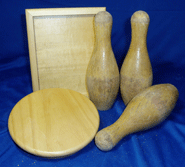
When you’re going to paint on varnished wood, all you need to do is sand it well to take off the surface shine.
If it’s really old and worn, then the varnish may be flaking. In this case, just sand so that the flaking edges become smooth and no longer threaten to peel any further.
That's what we did to this children's antique bowling set. The varnish was chipping off very easily.
Just a light sanding will do...

And you’ll be glad to know that it’s not necessary to sand down to the bare wood… that is unless you want to use a wood stain.
See how the toppled bowling pin has lost its sheen?
And then when the sanding is done to your satisfaction, wipe down the surface with a slightly damp, lint-free cloth.
Painted Wood
It’s a fact that most previously used wood pieces will have some
combination of paint and varnish. Blistering or peeling paint can be
removed with a scraping tool and then sanded smooth.
If you like the color of the paint that’s already there, then just clean
the surface with Tri-Sodium Phosphate (TSP). Rinse it well and let
dry.
And of course, you may love the nostalgic appeal of old, chipped paint
for really charming backgrounds. Again, it’s a simple matter of
cleaning and preparing the surface. The fun part is you can start
painting right away without a lot of fuss.
Considerations
In dealing with these old finishes, you may experience a problem if the finish is oil-based. Since most decorative painters use acrylics… well let’s just say that acrylic paints don’t play well with oils, if they’re placed on top.
Here’s a really good way to test for oil-based paints. Take a cotton swab dipped in rubbing alcohol and rub it on the surface. If some of the old paint comes off on the swab, then it’s likely acrylic.
And seriously, when in doubt, just apply a coat of primer. It’s good insurance. The fact that the finish is old increases the chances that it's oil-based.
When you are faced with multiple layers of paint and varnish, you may need to strip the piece entirely. How motivated are you to paint on it? It’s a judgment call only you can make.
Some of our most treasured project pieces were buried under layers of dust and many coats of paint and varnish. So, don’t let it deter you from painting on a fabulous find. Clean it up! You won’t regret it.
You may contact me here if you have any questions, or if you'd like to share some tips or ideas. I'd love to hear from you!!
Let's leave Paint and Varnish and go to Wood Finishes.
Return to our Decorative Painting Home Page.
You Can Paint These Trees and More

Get Your Video Course Now
Introductory Price
Save 55% plus
a Money Back Guarantee


You Can Paint These Trees and More
Get Your Video Course Now
Introductory Price
Save 55% plus
a Money Back Guarantee
Recent Articles

-
Preserving artwork
Apr 18, 24 03:38 PM
Cheryl, Is it necessary to spray artwork with an acrylic spray if I use a quality canvas listed as “archival”? Cheryl, are you still writing newsletters? -
Can you paint more after setting in oven?
Feb 16, 24 06:36 AM
 Hi there I had taken a class and painted a wine glass, then set the paint in the oven. Can I add more paint or designs and re-sent again in the oven?
 -
gallery glass
Dec 11, 23 07:44 AM
Can Gallery Glass be restored if it has thickened? -
gallery glass
Sep 19, 23 07:44 AM
Can Gallery Glass be restored if it has thickened? -
Looking to commission an artist to paint a milk churn for me!
Sep 19, 23 07:43 AM
Greetings I am looking to commission a recognized artist in this field do you or someone you could recommend my name is Lesley Kelly Cell 403 512 8911 -
GLAZE FINISH - what is available now?
Sep 19, 23 07:42 AM
As you said, Delta PermEnamels are discontinued. I would finish off fixing my ceramic vintage pieces with their glaze (either clear gloss or satin). -
Glass Paint Temperature Considerations?
May 15, 22 11:10 AM
I’m wondering how durable glass paint/faux leading is giving shifting temperatures? Or, if some glass paint brands are better for this than others? For
Site Search
| site search by freefind | advanced |


You Can Paint These Trees and More
Get Your Video Course Now
Introductory Price
Save 55% plus
a Money Back Guarantee
New! Comments
Have your say about what you just read! Leave me a comment in the box below.